Students interviews - Hekate “Kikkavi” Project - interview with Ypatia Kornarou - Moments Collective
Interview with Ypatia Kornarou
What does your first photographic work “Kikkavi” negotiate?
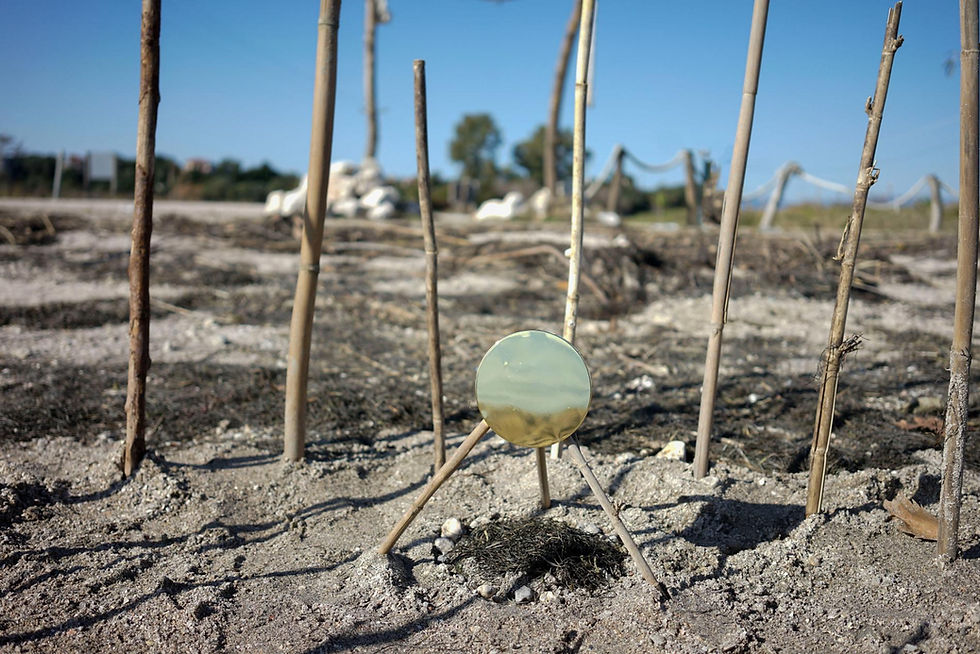
From the past to the present, society demands that femininities remain silent. Those who do not remain silent face the consequences.They are mocked, labeled as hysterical, insane. Those who refuse to be silent are disparaged, attacked, marginalized, murdered. Yet those who choose silence are condemned to carry the weight of chronic oppression without complaint.Systemic oppression, deeply rooted, has etched indelible marks on our souls and bodies, passing down from generation to generation. We embody this oppression and constantly experience within us all the social barriers and norms, manifesting psychosomatic symptoms and compulsions.We stuff our mouths in an attempt to contain everything that is demanded of us. We swallow the oppression until it clogs our throat, sits heavily on our chest, and deprives us of any possibility of expression and communication. In the first part of this work, I delve into the consequences and psychosomatic disorders caused by the silence that is boldly imposed upon us.
In the second part, I draw inspiration from fictional characters as well as real individuals who became symbols of resistance (such as “Naked Athena” during the U.S. protests in July 2020), seeking to depict liberation from social stereotypes through the act of listening, exploring, and reclaiming our bodies as an inseparable part of nature — and with nature’s support.

@Hekate
So, what is it ultimately about? What is the story you want to tell?
It is a story of death and rebirth a story in which we draw strength from the very elements that once harmed us.They buried us in the earth, yet we claimed it, nested within it, and were reborn.They hung us from the trees, but we spoke to them and climbed their highest branches to become invulnerable.They drowned us in the water, yet the water gave us breath again and healed us.

@Hekate
Where does the title of the series draw its inspiration from?
The title of the work, “Kikkavi,” is inspired by the owl’s presence in folklore, where it appears both as a symbol of wisdom and as a harbinger of misfortune. This dual meaning remains relevant today, functioning as a label often imposed on femininities, who are expected to conform to the narrow confines of one role or the other, according to patriarchal dictates and regardless of their own desires.

@Hekate
I know there is also a song that accompanies the work. Tell us about it. How did this collaboration come about?
The song Sclupa, which accompanies my work, is a descriptive improvisation inspired by the tuning calls of the gionis birds (known as sclupes in the Ikaria dialect and other regional variations) and by the nocturnal soundscape. One gionis calls to another, trying to synchronize their hooting, and soon the entire forest, mountain, or empty plane tree–filled square becomes saturated with their monotonous, otherworldly sound.
This is how I imagine the way femininities around the world weave bonds, attune to one another, and find the strength to stand against every form of oppression.
All the photographs in this work were taken enveloped by the soundscape of the night, a time of day that for me is profoundly introspective and imbued with an almost metaphysical sense.The creator of the song is Marianina Kalokairinou, whom I thank with all my heart for allowing me to use it.

@Hekate
What does it mean to be a photographer? Is it ultimately time and memory that make an image powerful? Or is it something else, something more personal?
Yes, in part, what each person carries through time, memory, and lived experience is what connects the viewer to a photographic work and makes an image powerful. But this can happen not only because a memory is awakened, but because the photographer’s personal gaze reveals something we had never seen or felt before — something we nonetheless carry within us in a latent form, waiting for this visual dialogue to bring it to light.

@Hekate
How do you handle the transition from concept to visual expression? What is it like to transcend the limits of simple representation?
For me, the process begins with an idea I want to communicate .To achieve that, I need to dive into what I’m feeling into whatever occupies my mind most intensely at that given moment and try to put it in order so I can process it more clearly.This is how an image is born that carries all of that within it.
Ultimately, the process is deeply therapeutic.

@Hekate
@Hekate @Hekate @Hekate @Hekate @Hekate @Hekate @Hekate @Hekate @Hekate @Hekate @Hekate @Hekate @Hekate @Hekate @Hekate
Author Ypatia Kornarou - Moments Collective @2025


Comments